
January 21 Newsletter
January 1, 2021
Business Update

How to pivot your business so that you stay in business
As we begin 2021 and we are all in some kind of lockdown, we may need to think again about what we can adapt to survive and thrive. You could be a business that actually grows this year!
Here is how to pivot your business to make sure you stay in business.
A 7-step guide to pivot your business
1. Get into the right mindset for decision-making
Take time out, prioritise self-care and deep thinking time, and you’ll make far more creative decisions for it.
2. Think about what you can change for the good
Can you change your product or service to become more relevant? Can you change your intended marketplace for your product or service? Can you change how you deliver your product or service?
3. Do your research
Ask and listen to your customers – what are they telling you they need? How are habits and hobbies changing as people stay home more? What is social media telling you that people are doing or thinking about?
4. Conduct a STEEPLED analysis to look ahead
Use the STEEPLED analysis and think about what each factor will mean for you and your business (e.g. follow each example with a ‘so what’ for your business): S – Social – e.g. more people are staying/working at home. T – Technology – e.g. more older generations are adopting technology to stay in touch. E – Environment – e.g. people can see it recovering. E – Ethics – e.g. can’t be seen to be profiteering. P – Political – e.g. will this change Brexit, Tory government etc? L – Legal and regulatory – e.g. how will rules, protocols change? E – Economic – e.g. what happens with a recession? D – Demographic – e.g. what age group are you trying to attract.
5. Evaluate your potential options
Once you have done your research about the current market and you’re in the right mindset to adapt your business, you now need to evaluate your options. For each option, think about: ● How connected is it to your ‘why’ or ‘purpose?’ ● How easy is it to implement? ● What will change or stay the same? ● If you chose to move forward with this, what would you and your business have to do? 6. Conduct a risk analysis
Once you have chosen what option you are pursuing, conduct a risk analysis: ● Consider some ‘what if’ scenarios - e.g. what if schools close again and people have to work and provide childcare? ● Review your risks - e.g. operational, reputational, project delivery, political, environmental, financial etc. ● Rank these risks – are they high, medium or low risk? ● Review their impact – what would be the impact on the business if this risk happened? ● Outline your red lines – which risks can you accept or avoid? Which risks need to be managed? 7. Put together your business plan Last but not least, if you’re going to pivot your business towards success, you need to have a plan. What are your new goals and achievements? Once you have these, you need to outline: ● How you will measure your progress. ● How much investment you will need. ● Who you will need to support you with this. ● Who in your current circle of people is critical or now not needed. ● Your first steps to making this happen. As you can see there’s lots to consider, but also potentially lots to gain from thinking it all through and making the change.
Accounting Update

Personal Tax Return deadline
HMRC receive over 11 million digital tax returns each year. Last year more than 700,000 submitted their tax returns on deadline day (31st January). The peak hour for filing was between 4pm and 5pm when 56,969 were filed. And thousands more left it to the last minute, 26,562 completed their returns between 11pm and 11.59pm!
Please remember that the personal tax return needs to be filed and paid by 11.59pm on 31st January 2021 .
If you think that you may be unable to pay the outstanding amount by the deadline, HMRC may be able to spread the cost through a Self-Serve Time to Pay arrangement. You can read more here . Alternatively, you can call their helpline on 0300 200 3822, Monday to Friday, 8am to 4pm.
The Coronavirus Job Retention Scheme (JRS) The Coronavirus Job Retention Scheme is being extended (again) until 30 April 2021.
Please see here for the updated guidance. Claims from 1 November must be submitted by 11.59pm, 14 calendar days after the month you’re claiming for. E.g. a claim for furlough days in December must be submitted by 14th January 2021.
Note, that you can make your claim more than 14 days in advance of the pay date (if you pay your employee in arrears). Remember to keep records of the hours that are worked (and not worked) for 6 years .
App of the month

Diib
Diib makes incredible online growth easy for any business owner, anywhere in the world.
Every business needs a Growth Plan! Diib will quickly show you how to easily improve your:
F eeling busy? Your new Weekly Snapshot gives you a quick glimpse into how your business is performing online.
... and so much more
Team News
Happy New Year from Youtopia!
We would like to wish you all a very Happy New Year! We are very optimistic about 2021 and the opportunities and reunions that it will bring. If there is anything you would like to discuss, then please give us a call on 01908 751 972. Keep safe and well,
Keep safe and well,
Katherine, David and Kasia
Diib makes incredible online growth easy for any business owner, anywhere in the world.
Every business needs a Growth Plan! Diib will quickly show you how to easily improve your:
- SEO
- Social
- Mobile
- Visitor experience based on real data
Weekly Snapshot email
F eeling busy? Your new Weekly Snapshot gives you a quick glimpse into how your business is performing online.
- Traffic and rankings changes
- Social performance and local map (if applicable) statistics
- New opportunities for growth
- Security, speed, and SEO overview
... and so much more
Team News
Happy New Year from Youtopia!
We would like to wish you all a very Happy New Year! We are very optimistic about 2021 and the opportunities and reunions that it will bring. If there is anything you would like to discuss, then please give us a call on 01908 751 972. Keep safe and well,
Keep safe and well,
Katherine, David and Kasia

In Part 1 of this series, Dr Anita Devi opened the conversation on the rising complexity of SEND and the need for intentional, values-driven provision. Her reflections focused on inclusive leadership, purposeful commissioning, and the principle that less can often be more . In this second part, I’d like to continue the conversation — but from a financial perspective. My name is Katherine Robertson. I’ve spent over 10 years working with organisations across sectors including the education sector, helping them to navigate their finances confidently and strategically. What I’ve learned over that time is simple: money follows priorities — but only when we lead with clarity . And now, with SEND needs rising faster than school income, we must work smarter than ever with the resources we have. 🎯 From Stockpiling to Strategic Spending In 2024, the Department for Education wrote to 64 academy trusts, concerned that some were holding onto reserves more than 100% of their annual income . These aren’t just large numbers — they are untapped opportunities. Of course, we know why these reserves exist: financial uncertainty, poor capital funding, and the understandable desire to protect future viability. But if money meant for today’s pupils is held for tomorrow’s problems , we risk doing a disservice to the very learners we aim to support. That’s why we’re asking an important question: Can schools and trusts use their reserves to strengthen inclusion and SEND support now, without compromising their long-term financial security? Our answer is yes — with the right approach. 🧩 Applying Financial Wisdom to Inclusive Practice We are not advocating reckless spending or draining reserves dry. On the contrary, we work with leaders to build a clear, defensible strategy for using reserves wisely , backed by robust modelling, compliance with DfE guidance, and an unwavering focus on improving outcomes for children with SEND. Together with Dr Anita Devi, we bring dual lens: educational insight and financial clarity. Here’s how we help to: ● Identify untapped funding within existing reserves ● Co-develop an evidence-led SEND investment plan ● Align to DfE expectations on reserve levels and financial health ● Build the narrative for governors, trustees, auditors and regulators ● Support ongoing evaluation to ensure value for money and impact It’s not about spending more. It’s about spending better . 🔄 Releasing Funds. Reinforcing Purpose. SEND needs are not going away — and nor are the financial pressures. But when finance and inclusion experts work together, we can unlock solutions that support both pupil outcomes and institutional resilience . With careful planning, strategic reserve use can: ● Fund early intervention ● Invest in staff development ● Improve provision infrastructure ● And reduce future costs from reactive SEND placements or escalation It’s a long-term gain — and a value-led approach to financial governance. 💬 Let’s Continue the Conversation If you’re sitting on reserves and wondering how best to use them — or if you’re just ready to rethink how your SEND resources are working for you — we’re here to help. We offer a tailored advisory service that helps schools and trusts plan, invest and lead with both head and heart. 📩 Reach out at SEND_Finance@youtopia.co.uk to book a preliminary conversation. Because sometimes, the smartest way to save — is to spend with purpose. Author: Katherine Robertson Strategic Finance Expert and Education Consultant In partnership with Dr Anita Devi – Leading SEND Specialist
Optimize spending for better SEND outcomes. Contact Youtopia Ltd for expert finance support in Milton Keynes.

Starting and growing a business is no easy feat.

Ever wondered how a small business survived by pivoting from exhibitions to outdoor cinemas during the pandemic?
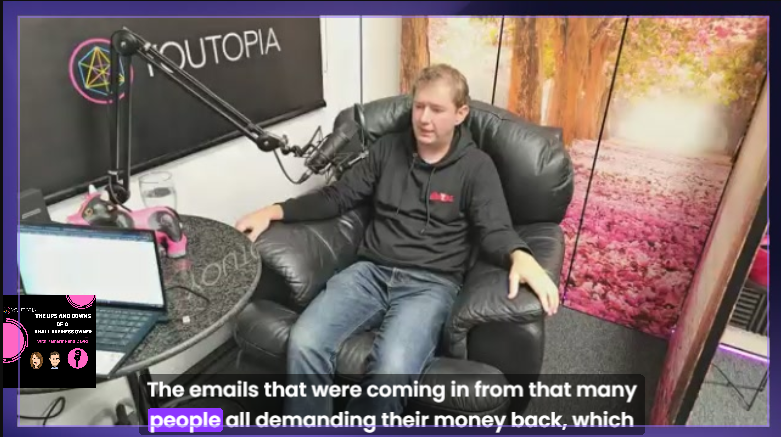

Discover the unexpected source that helped a small business owner overcome burnout. It's not what you think. Stay tuned for the surprising twist!

Running a small business is no easy feat.

Finding balance as a working parent can feel like an impossible tightrope walk.

This is a subtitle for your new post

Gemma Downing is no stranger to adversity.